Every hair extension package says "100% human hair." Almost none of them tell you whether that hair is Remy.
That one word — or its absence — is the biggest predictor of how your extensions will actually look and feel six weeks from now. It's the difference between hair that still moves like your own after months of wear, and hair that tangles into a matted mess after a handful of washes. Yet it's the detail most brands leave out entirely.
Here's what Remy actually means, why non-Remy hair behaves the way it does, and how to tell which one you're getting.
What "Remy" Actually Means
Remy isn't a grade of hair or a marketing tier — it's a description of how the hair was collected.
Every strand of human hair has a cuticle: a microscopic, scale-like outer layer that runs in one direction, from root to tip, like shingles on a roof. When hair is collected in a way that keeps every strand's cuticle facing the same direction and preserves the natural root-to-tip order, it's called Remy hair.
Picture a deck of cards. If every card is facing the same way, the deck stays neat — cards slide smoothly against each other. Now imagine a handful of those cards flipped at random. The deck catches, snags, and won't sit flat. That's the difference between Remy and non-Remy hair, at a microscopic level, multiplied across thousands of strands in a single extension weft.
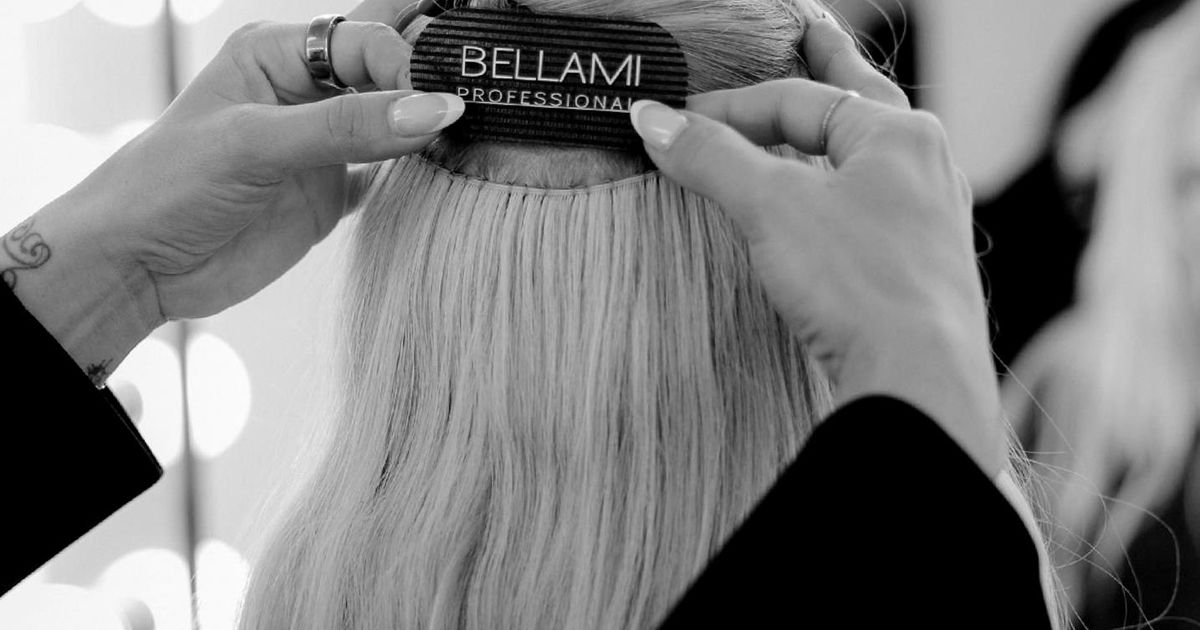
BELLAMI is made from 100% Virgin Remy human hair — Remy hair that has also never been chemically processed, permed, or colored at the source. "Virgin" and "Remy" solve two different problems: Remy keeps the cuticle aligned so the hair doesn't tangle, and virgin means the hair's natural structure hasn't already been altered before it ever reaches production.
What Non-Remy Hair Actually Is
Non-Remy hair is usually collected from mixed, untraceable sources — hairbrush waste, salon floor sweepings, or hair gathered from many different donors and blended together without regard to cuticle direction.
Because the strands face different directions, non-Remy hair tangles against itself almost immediately. To mask this, most non-Remy hair is chemically stripped of its outer cuticle layer entirely (a process called acid bathing) and then coated in silicone to fake a smooth, shiny finish.
That silicone coating is doing a lot of work — and it doesn't last. Every wash strips a little more of it away. Somewhere between week two and week six, the coating is gone, the underlying cuticle-less hair is exposed, and the extensions start to feel dry, dull, and tangle-prone — often permanently matted at the wefts. This is the single most common complaint about cheap hair extensions, and it's almost always a non-Remy problem, not a "you did something wrong" problem.
How to Tell the Difference
Because "100% human hair" is technically true of both Remy and non-Remy products, it's not a reliable signal on its own. A few things are:
- Does the brand specifically say "Remy" or "Virgin Remy"? If sourcing language stops at "human hair," that's often a sign the cuticle wasn't preserved.
- How does it feel dry, out of the packet? Non-Remy hair coated in silicone often feels unusually soft and shiny at first — smoother than real, healthy hair typically feels.
- How does it look after a few washes? Remy hair should still move and separate easily. Non-Remy hair tends to dull and tangle noticeably fast.
- Can you run your fingers root-to-tip smoothly, but feel resistance tip-to-root? That's cuticle alignment at work — a hallmark of genuine Remy hair.
Why This Distinction Drives Everything Else
Once hair is properly Remy, everything downstream gets easier: it holds color and heat styling more like natural hair, it resists matting through normal wear, and it lasts through its full lifespan (BELLAMI extensions are built to last 6–12 months with proper care) instead of degrading within weeks.
This is why we lead with it. "100% Virgin Remy human hair" isn't a phrase we use loosely — it's the specific, verifiable standard every BELLAMI product is built on, checked through our 4-Point Quality Check before anything reaches a stylist's chair or a customer's head. In a category where sourcing claims are often vague by design, we'd rather you know exactly what you're paying for.
The next time you're comparing extensions — BELLAMI or otherwise — skip past "100% human hair" and look for the word that actually tells you something: Remy.


